MIERCOLES, EL CATORCE DE JULIO, VEINTE-DIEZ A sign on the way back from Sth Berkeley down Shattuck Ave, nearby is the Berkeley Bowl, a great place for fresh bread, great produce and a stunning collection of beers including Scrimshaw Pilsner.
MARTES, EL TRECE DE JULIO, VEINTE-DIEZ Two pets that we've been looking after over the past few weeks. On the left is Tiny, who we looked after in Putiki in Whanganui, New Zealand. She's a feisty number but happy to chat after you get to know her. Now we're looking after Senor O, a brilliant dog, originally from Barcelona, Spain, now residing in Oakland, California. Belly scratches mandatory.
LUNES, EL DOCE DE JULIO, VEINTE-DIEZ Bye bye New Zealand, especially Whanganui. (Photo by JK Russ at 'Eye of Night' (RIP) circa Nov, 2009)
DOMINGO, EL ONCE DE JULIO, VEINTE-DIEZ The final state of my palette, Putiki, Whanganui
SABATO, EL DIEZ DE JULIO, VEINTE-DIEZ Below are the final three works I'll finish in New Zealand. They are intended as a triptych and read as a narrative. From left to right they are titled Creator, Nurturer and Lifegiver. The are all oil on metal and framed in a Mexican Colonial style. The photo was taken at Paul Maseyk's studio in Putiki, Whanganui.
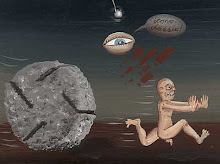
VIERNES, EL NUEVE DE JULIO, VEINTE-DIEZ Tonight is the opening of the Carey, Smith and Co Whanganui Arts Review at the Sarjeant Gallery. It's always a huge turn-out and a good chance to catch up with locals. I've got the alien painting below in the exhibition and Jo has one of her new, framed collages. Might see you there....
JUEVES, EL OCHO DE JULIO, VEINTE-DIEZ Meta-redux/revisit to San Marco Convent in Florence. I'm holding up my catalogue from my exhibition, The Museum of Inherent Vicefrom 2007. In the catalogue is a photo I took during my first visit to San Marco in 2004, featuring a conservator painting a fresco in one of the exterior apses in the courtyard. I returned in 2008 and decided to re-photograph the same scene but with the finished fresco. I also did this at the Brancacci Chapel in Santa Del Carmine with Masaccio's Tribute Money fresco cycle (I'd used the disciples from the fresco in a painting of mine) and also in the Vatican with Raphael's School of Athens, of which I'd used the swastika-decorated arch that frames the fresco.
MIERCOLES, EL SIETE DE JULIO, VEINTE-DIEZ I've just finished a couple of new scrimshaw (which I'll post here soon) and while I was looking through my archives, I found images of a scrimshaw object in the North Otago Museum in Oamaru (bottom, right). After returning from a trip around the South Island in 2005, I made the Oamaru Altar(top and bottom, left; 2006, 380 x 300 x 310mm,oil on found wooden bowls, scrimshaw, wire and thirty New Zealand five-cent coins). I wanted to add something in the centre of the scrimshaw as they look like an archway so I painted a small wooden bowl that was kicking around. The photograph of Christ I took at St. Patrick's basilica in Oamaru. I was pretty close to deleting this image, until I uploaded it onto my computer was stuck by its Cubist or Futurist-type aura or penumbra.
This work is part of a private collection in Petone.
EL SEIS DE JULIO, VEINTE-DIEZ Philip Guston paintings at MOMA from the Edward R. Broida bequest, 2008. (Click on the image to enlarge it)
LUNES, EL CINCO DE JULIO, VEINTE-DIEZ Las Vegas, Fourth of July, 2008 (sans fireworks)
FELIZ CUATRO DE JULIO! Bath Salts, (recto) 2005, oil on two canvases, 480mm x 330mm (John Trumbull vs. Marcus King)
SABATO, EL TRES DE JULIO, VEINTE-DIEZ A mighty-fine day today, doing domestic duties while psycho-dog looks on.
I'm often trawling the internet for retablos for sale and I came across the one on the left (excuse the poor quality of image) of San Jose or Saint Joseph. It interested me because it very well could be by the same artist who painted a San Jose retablo that I own (right). Often, the attributes of each saint were replicated by many artists so that there was a continuity of symbolism of the saint, so sometimes what you think is a retablo by Geronimo de Leon or the Beestung Lip painter is a copy of them, or possibly both the artists had drawn from the same source, such as a Spanish Colonial painting or a hand-coloured print. In this case, I feel pretty certain that both these retablo are painted from the same hand or at least from the same production studio. Even though the retablo on the left is more loosely painted, it's a bigger retablo than the one on the left, so usually the artist would have kept his concentration of detail for the smaller scale retablos. Another giveaway is the way the isometric or orthographically formed structures (such as a the table on the left and the bible on the right) are constructed and painted. These objects are like they've been copied from a fish-eye lens image of the form. A strong indicator of the artist's hand is the way the faces were painted, but because of the low resolution of the image on the left and the damage to the paint surface on the retablo on the right, it's too hard to assertain the similarities AND of course the colours - which was the first thing that piqued my interest.
JUEVES, EL UNO DE JULIO, VEINTE-DIEZ I've just been sorting out my box of oil paints, to see which ones to store (you can't travel with oil-paints because they're flammable ... I found that out the hard way at LAX in 2003) and I found this very small and very old tube of Windsor & Newton cadmium scarlet. It was given to me by Rob McLeod in about 2002 and there was a point where I was mixing a brush-hair-worth of it through every colour I used to paint with. It gave the colours a beautiful smoky, hazy quality to them, which was needed for the paintings I was painting around 2004 - 2006 that had primarily white, neutral backdrops. I've bought newer tubes of this exact brand and colour, for exorbitant amounts of money, but none of them have matched the pigment quality of this tiny tube. Thanks Rob!
MIERCOLES, EL TRIENTE DE JUNIO, VEINTE-DIEZ ANOTHER WORK I'M MISSING LOOKING AT: Helm Ruifrok'sThe Virgin and St Anne (after Da Vinci), (1999, conte on paper, acquired 1999). We always have this hanging in our bedroom, except for it's brief stint in a friends lounge while we were overseas in 2008.
MARTES, EL VEINTINUEVE DE JUNIO, VEINTE-DIEZ Now that we're unofficially in transit, I'm really starting to miss the 'familiar' things that we used to look at everyday, notably many of our artworks. One of the works I seem to be missing the most is a set of glazed ceramic tiles by Scott McFarlane that used hang on an adjacent wall to the stove in our kitchen. While cooking, these works would keep me company and I'd be drawn into their individual symbolism. Jo and I selected these particular works one night after dinner and several beers with Scott. I'm really pleased with our selection as it seems to balance symbols of abstraction, parochial New Zealand, Western art history and contentious contemporary events and paranoia.
LUNES, EL VEINTIOCHO DE JUNIO, VEINTE-DIEZ The image below arrived in my inbox last week - a nice surprise to see one of my Whiteworld drawings framed up and hanging on the wall at my friend's house in the Wairarapa. The drawing is a profile of Joseph Merrick, aka 'The Elephant Man' (you need to scroll about 3/4th's down the page and he's in the left-hand column). He's probably one of the original '27 Club' although he wasn't a musician, but an amazing model-maker and a Freak-Show curiosity. I do like the casio-tone on the floor - Obviously a photographer has taken this image.
DOMINGO, EL VEINTISIETE DE JUNIO, VEINTE-DIEZ
The past year here in Whanganui so far has been a cyclic year. By that I mean my work has picked up on older aspects of my practice, including specific compositions used in the past and a rejigging and re-interpretation of symbolism. When this happens, the progression in my work feels like it's slowing down, but the intricacy of the reassessing of symbolism is very rewarding at the time of drawing and painting. The cycles seem to be in three-year spells, the weird thing is that I find myself rummaging through all my sketchbooks, dating back to 1995 and redrawing images into my most recent sketchbook without realising it, so I guess that's the main reason for the re-infection of older ideas. I guess you never totally empty out a vein that you're mining at the time, so you go back to it, reinvestigate, mine a bit more. Serendipity also seems to play a big part too, as in the image below for instance. I've drawn over the etching below to give it new life and to try out some new compositional ideas that I've been using in recent retablos. The original etching, titled Faith Waste was copied from a drawing of the same titled from 2004, now in a private collection in Wellington (scroll down about 3/4's of the page to view). Recently, when sending some works to a gallery, I found some of the test prints of the etching in a folder, so I decided to draw on them. One of the results is shown below.
SABATO, EL VEINTISEIS DE JUNIO, VEINTE-DIEZ Just a reminder that the Creative Hawke's Bay Invitational Exhibitionis finishing this Sunday at the Hastings City Art Gallery. Below is a detail on one of the works I have in the exhibition, Rectángulo De Tiempos Del Final(2009, Oil on wood and a leaf; scrimshaw and nails, 325mm x 770mm x 90mm). The half head/half skull is a classic I've been using a lot recently, a pertinent symbol of mortality, copied from a very small German bone carving I saw at the Met in NYC. Since then, I've found many images of the half and half kind, some of the best are 19th century Italian wax sculptures, used as medical guide, I believe. The dodo is also a great symbol for mortality, first used at artschool in a set of drawings in 1997. I started reusing the dodo in my paintings in 2003. He's holding a bank note in his beak and is standing on Charlemagne's chalice.
VIERNES, EL VEINTICINCO DE JUNIO, VEINTE-DIEZ I am attempting (in vane, I might add at the moment) to photograph the majority of pages out of my 'resource books'. As we're leaving the bulk of our book collection in storage, I think I'll feel a bit lost without all those beautiful art tomes to leaf through. Although the majority of the books I'm photographing seem to be about Spanish Baroque painting and Mexican folk art, one of my most coveted books is 'Fra Angelico: The San Marco Frescoes' by Paolo Morachiello. I had to buy a hardback copy of this edition after visiting the cloisters at San Marco Chapel in Florence. A truely magnificent place that taught me alot about composition, pictorial space; colour and line. Below is a couple of double page spreads of The Mocking of Christ by Fra Angelico. It has to be my favourite fresco ever - the disembodied hands and head, whipping and spitting at Christ is truely abstract in its concept. Throughout the book, are full scale detail reproductions of indivdual frescoes, making it the prefect resource book. *yikes! I just checked out the book on Amazon and it's USD$695.00! I'm glad I bought it when I did*